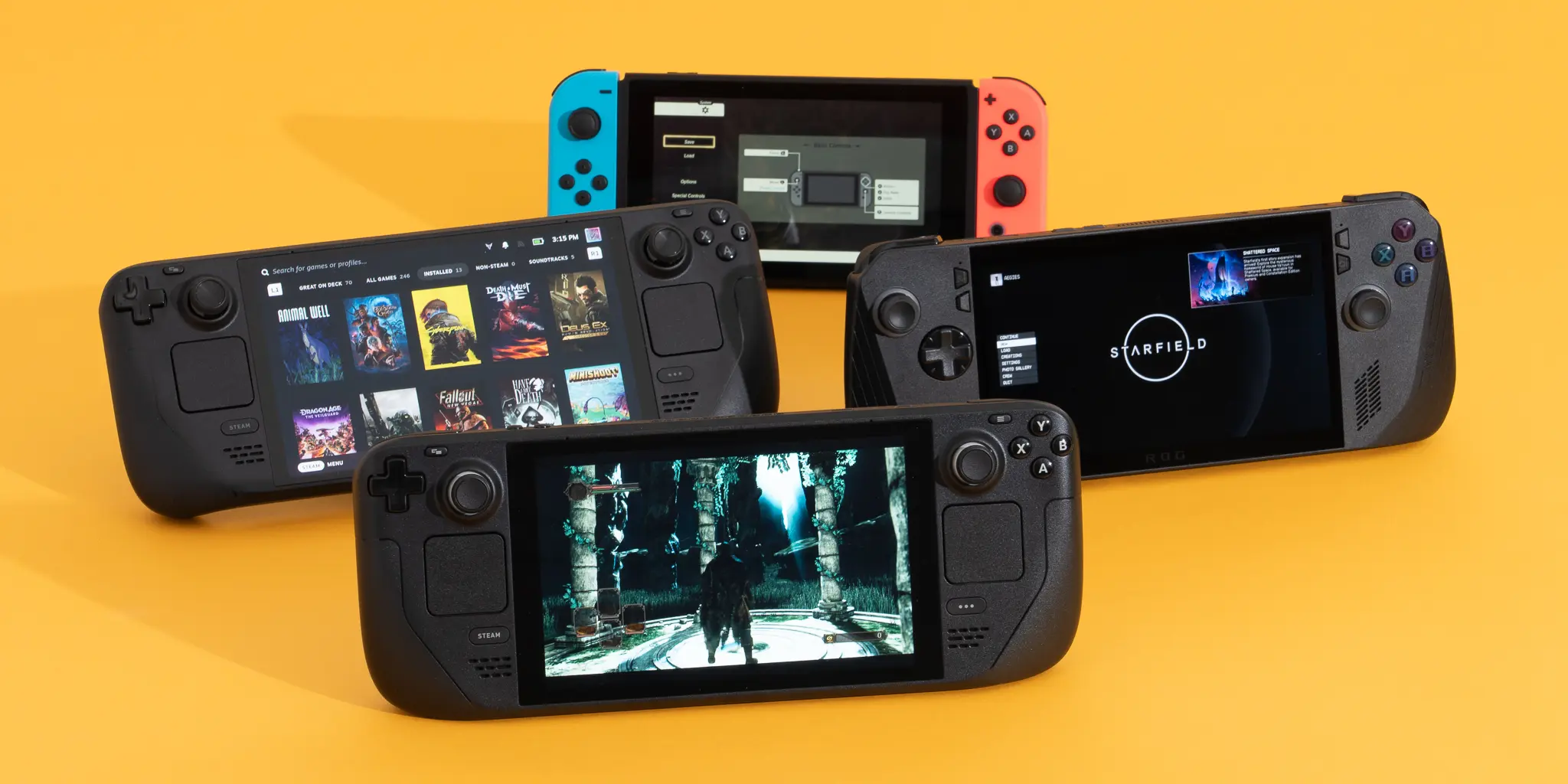
For a generation of gamers who grew up in the 1990s and early 2000s, the handheld was a sacred device. The Nintendo Game Boy, the Sega Game Gear, and later the Sony PlayStation Portable (PSP) were portals to portable adventures. Then, for a while, the dedicated gaming handheld seemed to fade, squeezed by the rise of powerful smartphones that could play casual games. But something remarkable has happened in recent years: the gaming handheld is not just back; it’s better than ever. Led by the Valve Steam Deck and the ASUS ROG Ally, a new category of powerful, PC-based handhelds has emerged, allowing gamers to play their favorite AAA titles anywhere, anytime.
Gaming Handhelds are Back: The Rise of the Steam Deck and ROG Ally
A Brief History of Handheld Gaming
The handheld market has long been dominated by Nintendo. From the Game Boy, which sold over 100 million units, to the Nintendo DS and the current Nintendo Switch, Nintendo has consistently understood the magic of portable gaming. The Switch, in particular, blurred the lines between home console and handheld, proving that gamers craved the freedom to play high-quality games on the go.
But the Switch, powerful as it is, is still a closed ecosystem. You can only play games that Nintendo allows on its platform. For PC gamers with massive libraries on Steam, Epic, or GOG, the Switch offered no solution. The dream of playing graphically demanding PC games like Cyberpunk 2077 or Elden Ring on a portable device seemed impossible. That is, until Valve released the Steam Deck.
The Steam Deck Revolution
When Valve announced the Steam Deck in 2021, the gaming world took notice. This was not a toy; it was a full-fledged PC, shrunk down into a handheld form factor. It ran Linux-based SteamOS, but it was powerful enough to run thousands of Windows-based PC games through a compatibility layer called Proton. For the first time, your entire Steam library could potentially fit in your hands.
The original Steam Deck was a revelation. It featured a custom AMD APU (a chip combining CPU and GPU) that delivered surprising performance, a crisp 7-inch screen, and a full suite of controls including thumbsticks, a D-pad, face buttons, and two innovative trackpads that allowed for mouse-like input in games that required it. It was chunky, it was a bit heavy, and the battery life was only so-so, but it worked. It worked astonishingly well. The dream of playing PC games on the go was real.
The Competition Heats Up: The ROG Ally and Beyond
The success of the Steam Deck did not go unnoticed. The PC gaming hardware giants, long focused on desktops and laptops, saw an opportunity. In 2023, ASUS released the ROG Ally, a direct competitor that took a different approach. Instead of Linux, the Ally ran Windows 11 natively. This meant it could run any PC game, from any store, without compatibility layers. It was also more powerful, featuring a newer, faster AMD Z1 Extreme chip, and a beautiful 1080p 120Hz screen.
The Ally was lighter, faster, and had a better screen than the Steam Deck. However, the Windows experience on a small touchscreen was clunky, and battery life was even worse. The battle lines were drawn: the Steam Deck offered a more polished, console-like experience with a massive library of verified games, while the ROG Ally offered raw power and universal compatibility at the cost of some polish and battery life. Other competitors have since joined, including the Lenovo Legion Go, which features a massive 8.8-inch screen and detachable controllers, leaning even further into the “portable PC” concept.
Why They Matter
The rise of these PC gaming handhelds matters for several reasons. First, they offer unprecedented freedom. Your gaming library is no longer tied to your desk. You can play your save game from your desktop, right where you left off, on the bus, in bed, or on vacation. Services like cloud saves make this seamless.
Second, they represent a convergence of gaming ecosystems. You’re not locked into one company’s store. On a Windows-based handheld like the ROG Ally, you can play games from Steam, Epic, Xbox Game Pass, GOG, and even emulators for older consoles. It’s an open platform for gaming.
Third, they are driving innovation. The competition between Valve, ASUS, Lenovo, and others is pushing the technology forward rapidly. Screens are getting better, chips are getting more efficient, and software is becoming more refined. We are still in the early days of this new category.
The Future of Handheld Gaming
What comes next? The next generation of devices will likely focus on improving battery life, the Achilles’ heel of current models. More efficient chips and larger batteries will extend playtime. Screens will get even better, with OLED technology becoming more common (Valve recently released an OLED model of the Steam Deck). Cloud gaming integration will also play a bigger role, allowing these devices to stream games from powerful remote servers, saving battery and expanding the library even further.
The PC gaming handheld is not a niche product anymore. It is a legitimate and growing category that offers a unique way to experience games. For anyone who loves gaming but values the freedom to play anywhere, the new generation of handhelds is nothing short of a dream come true.